Bringing Grandma Home
This book describes the personal journey taken by the author to discover the life of his paternal grandmother who suffered from schizophrenia. She was taken from the family home in Calgary by the Mounties in 1921 and never came home. She was committed to the Mental Hospital for the chronically mentally ill in Ponoka Alberta until her death in 1955. She was buried in the cemetery on the hospital grounds until she was dis-interred, cremated and reburied with her husband in the family plot in Calgary in 1976. Issues related to the stigma of mental illness that affected the family are discussed. The author became a psychiatrist and suggests he was the grandchild given the unconscious assignment to bring Grandma home. In the process he needed to work through psychological defenses held by the family but mainly his Father which included identifying the possible impact of a near-death experience suffered when his Father’s ship was sunk off Lands End in the English Channel on 8-8-44. The book celebrates the lives of a faith filled family.
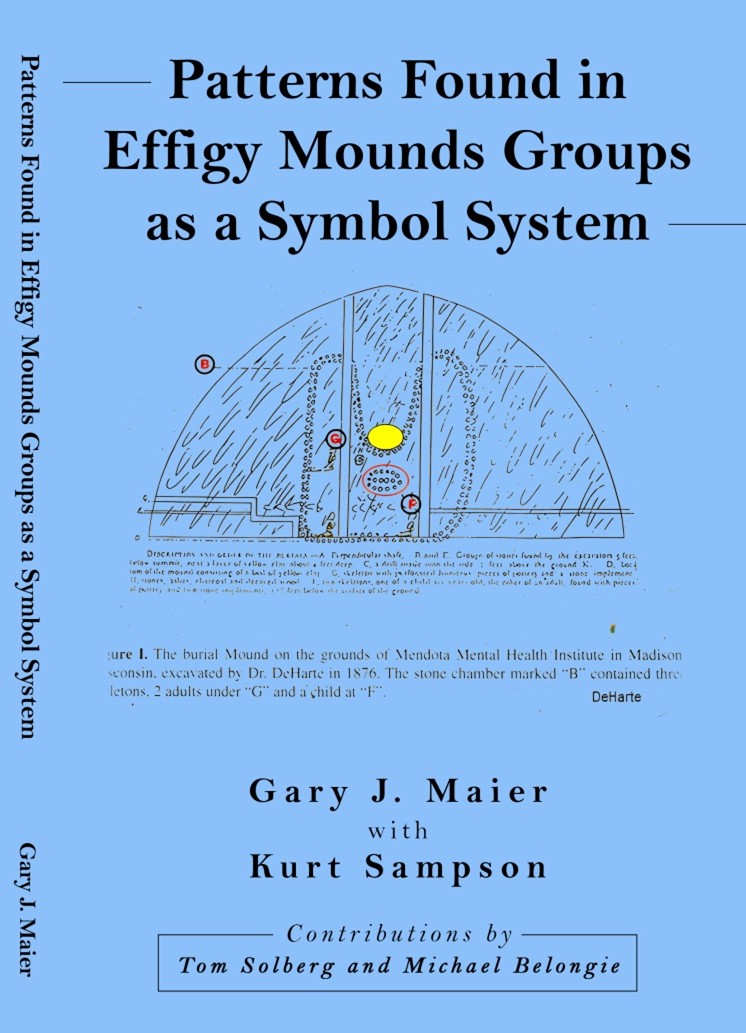
Patterns Found in Effigy Mounds Groups as a Symbol System
This book is the first to examine a series of mounds groups and show how repeating patterns found in the way the mounds are placed on the ground can be interpreted as a symbol system meant to communicate in earth writing aspects of the worldview of the Tribal ancestors responsible for their construction. As readers we have mastered the syntax that governs our English language and have learned how, by convention, to read our texts from left to right then down the page. The syntax governing the effigy symbol system uses four factors that provide the mounds group with dynamic meaning which also integrates aspects of the ethological adaptations of their Clan animal to seasonal change in the context of the role function of each Clan. The flow of a river, the contours of the terrain, the alignments of the sun on the horizon at the equinox and solstices and the alignment to the rise of the milky way all combine to provide dynamic direction to each group. The size of an effigy can act like topic sentence to provide a place to start to read the text. Since most mounds are considered “burial mounds” the effigy groups described in this book focus mainly on birth into the natural world, mortal death and re-birth into the spirit world. This is the second book by Dr. Maier which interprets effigy mounds groups and shows the maturation of his interpretive model.
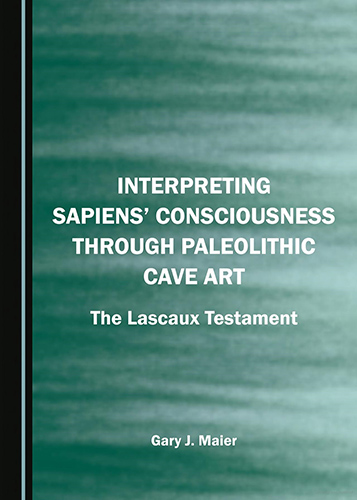
Interpreting Sapiens’ Consciousness through Paleolithic Cave Art
This book is the first to identify an interpretive path through Paleolithic cave art that can provide plausible meaning to the animal figures in the Lascaux cave in France. The artwork was created during a period described as the Creative Explosion, spanning from 35,000 to 11,000 BC. The author has found that the artists, or shamans, have left clear evidence of aspects of their worldview and by using ethological evidence, such as a bison shedding its winter coat to identify spring as the season portrayed in a specific panel, he adds a level of certainty to his interpretations.
In sum, this book argues that the cave art describes the journey of the soul from the spirit world to the natural world and back, and that it identifies a spectrum of consciousness involving the five traditional senses: sight, smell, touch, taste and hearing. Moreover, the book explores the hunting strategies employed early survival groups which are depicted in the cave art. The role of the shamans' impact on the artwork is also addressed.
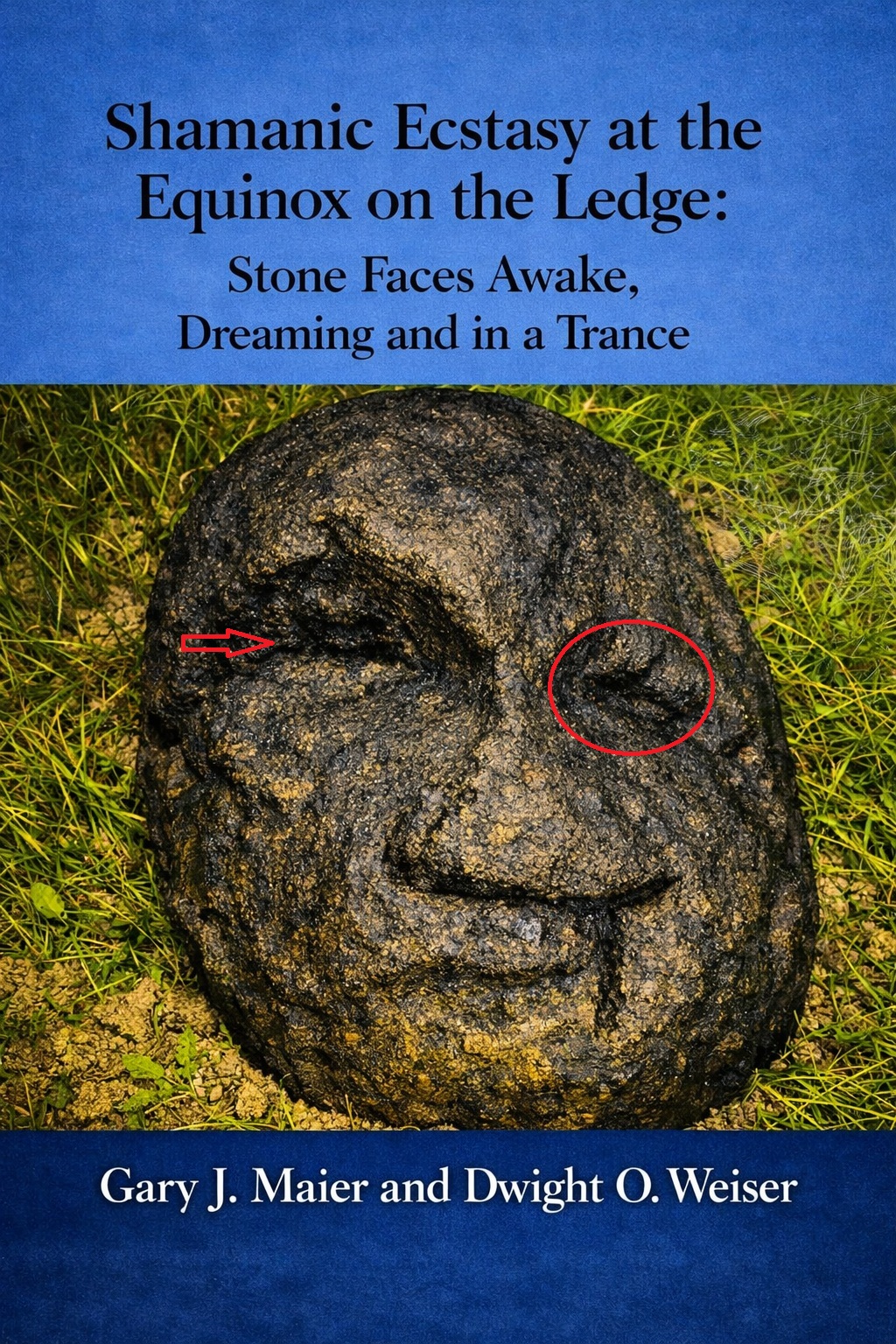
Shamanic Ecstasy at the Equinox on the Ledge: Stone Faces Awake, Dreaming and in a Trance.
The book cover shows a stone face found on the ledge by Professor Weiser which has the left eye open and the right eye closed. This face and four others are interpreted to identify the waking state of conscious, the open eye and the dream/trance state of consciousness, the closed eye. These faces, in concert with more than twenty other shamanic heads, appear to identify the capacity of the shaman to enter a trance, travel in the spirit world and return to waking consciousness. In this process the shaman may receive deeper insights into reality which provide the Tribes with the greater survival strategies.
This stone face is also located by a stream in a shallow valley aligned with a concial mound on top of the proximate hill that marks the sunrise on the equinox. It is a place where there is a conjunction of a shamanic influence with the older Tribal cultures who buried their dead in conical mounds. It is also suggested that the face could also represent Odin the one eyed god of the Norse who are now considered to have penetrated deep into this western country.

The Eagle's Voice
Gary Maier has written a thriller of the best kind: the mystery is ever out in front of his every sentence and the mystery he faces is that of himself as well as that of the Indian mounds. He excavates himself as unravels the mystery of the bodies and their burial. The book is a page-turner. The expertise he brings to it is fascinating.
The Eagle's Voice is unlike anything I have read dealing with the obvious symbolism of the effigy mounds.... Most Indian people recognize a 'feel' whenever they walk onto a site. I think this is what Gary Maier is trying to help the reader understand, and I believe he does a good job of it.